
Roswell City Directory Collections
The Roswell Public Library directory collection is the local starting point. Its partnership with Advantage Archives gives the public a route to scanned Roswell city directories and yearbooks. The verified collection is uneven, so each volume deserves its own check. A separate library index identifies older Roswell volumes, but the finding aid does not prove that every year between its listed examples survives. Publisher and abbreviation details belong to the title page and key inside the selected volume, not to a broad assumption about the whole run.
| Directory source | Years located | Keeper or location | Access route |
|---|---|---|---|
| Digitized Roswell city directories | 1947; 1971-1996 | Roswell Public Library and Advantage Archives | Public online collection, then inspect the page image |
| Older Roswell directory sequence | 1912-1936, with year-specific gaps possible | Allen County Public Library index and reference holdings | Consult listed volumes or ask a reference desk |
| Roswell high-school yearbooks | Exact years not located | Roswell Public Library digitized project | Use as dated school evidence, then verify in an image |
| Roswell Daily Record | Microfilm begins 1903 | Roswell Public Library | Microfilm, scanner, and library-linked archive route |
The collection report identifies completed scanning and indexing for 1947 and 1971 through 1996. It does not establish online coverage for 1948 through 1970. When a needed year is absent, the next channels are the library's physical and microform resources, a reference inquiry, Wilson-Cobb, and appointment-based archives. Note: Record the volume year and page or image identifier before treating an entry as evidence.
Roswell City Directory Online
The Roswell History Archives collection is the public landing point for the digitized run. It is a locally sponsored collection, not a replacement for every directory ever printed. Search a surname as it appears in the target era, then open the scanned page where the interface provides one. Copy initials and spelling exactly. A modernized spelling can conceal a useful match or join two different people.
The library's city-directory project shows the official collection route.
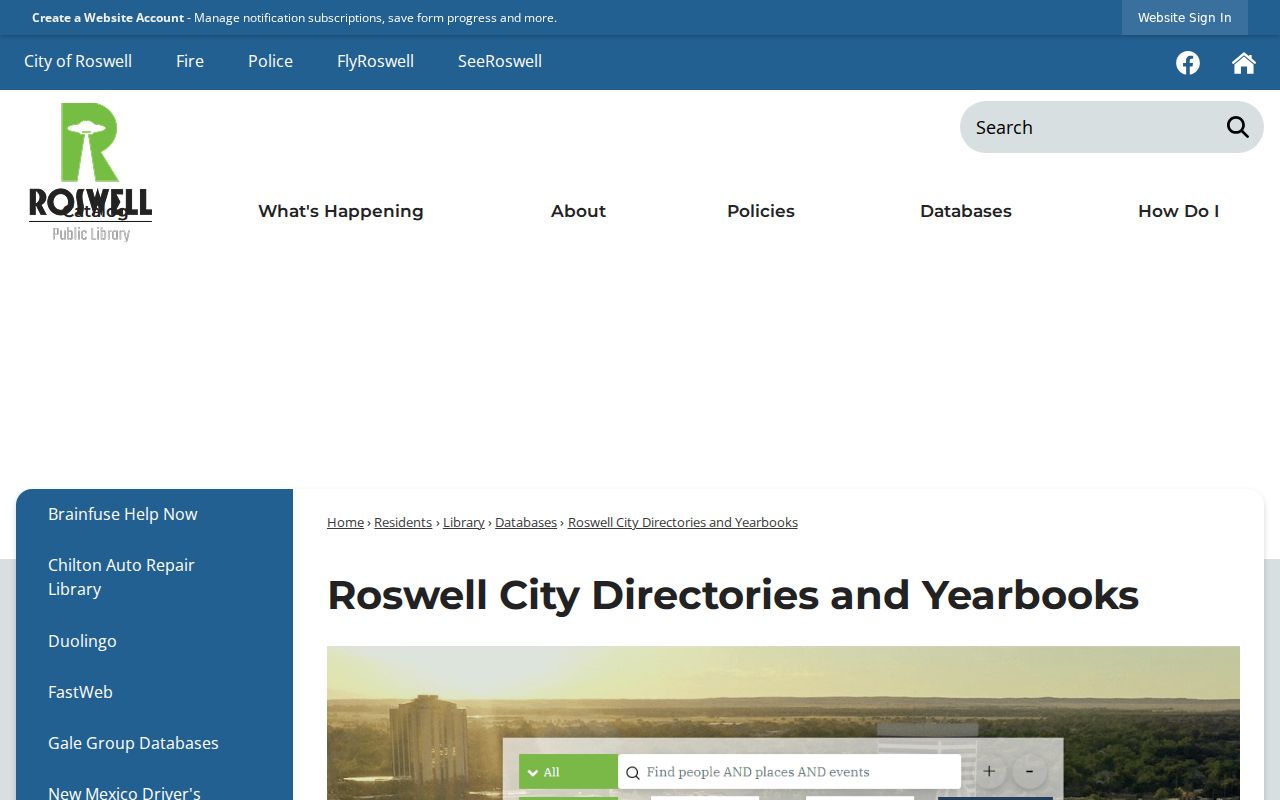
The project image supports a simple practice: start with the selected year and preserve the source image rather than relying on a search-result snippet.
Roswell Directory Research Desks
Roswell Public Library at 301 N. Pennsylvania Avenue is the main local desk for city directories, yearbooks, genealogy material, and microforms. Its posted regular hours are Monday through Thursday 10 to 7, Friday and Saturday 10 to 6, and Sunday 2 to 6, subject to notice. The library reports a digital microform scanner for viewing or printing film, fiche, books, and magazines. Ancestry Library Edition is available inside the library, not as a guaranteed home-access service.
Roswell History Archives supplies the digital collection route, while the Library databases listing points to local research tools and newspaper routes.
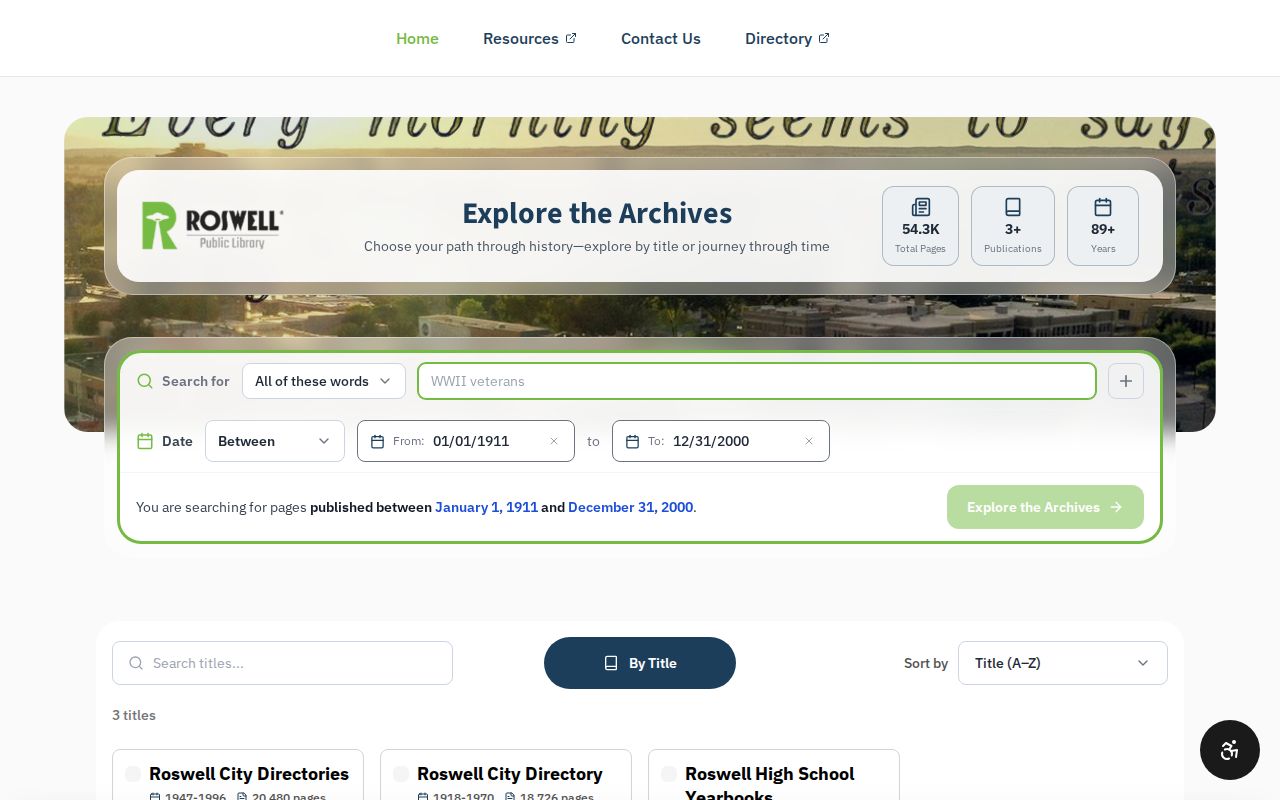
Use the collection screen to locate a candidate volume, then use the library's physical access routes when a year or a readable image is missing.
For specialty help, the Wilson-Cobb History and Genealogy Research Library offers free research use and asks visitors to call about exact holdings. The Historical Society for Southeast New Mexico keeps museum and archive materials available by scheduled research appointment.
Those access channels serve different needs. The public collection is best for a known digitized year. The Library can supply local books, microforms, and in-library databases. Wilson-Cobb may help identify a specialized holding before travel. The Historical Society is a route for archival context such as photographs, ephemera, family papers, and property stories. Ask for a collection name, volume, or date range instead of assuming that any archive operates as a name-search database.
Reading a Roswell City Directory
A city directory entry is a published, dated statement. Read the whole line before extracting a name. The actual Roswell viewer did not yield a person-specific entry for inspection, so a responsible reading method does not invent local symbols, owner marks, or spouse conventions. Instead, use the selected volume's title page and abbreviation key. Preserve each field that is printed and leave an unavailable field blank in research notes.
| Name spelling | Copy surnames, initials, and forenames exactly as printed. |
|---|---|
| Address line | Capture the full street wording and unit if the selected entry includes it. |
| Occupation or business | Record it only when the actual entry prints that wording. |
| Household clue | Preserve spouse, widow, organization, or cross-reference notation only when visible. |
| Volume citation | Keep the directory year, page or image, and publisher stated on that volume. |
- Criss-cross directory
- An address-ordered section that some editions include. Confirm it exists in the selected year before using it.
- Householder index
- An alphabetical aid centered on a household listing, which may omit others at the address.
- Abbreviation key
- The volume's own explanation of shortened words and symbols. Capture it before interpreting an unfamiliar entry.
Some city directories offer a reverse street section, while others do not. That difference matters when moving from a house number to a name. For a modern parcel or street question, use the separate Roswell street directory route rather than stretching a historic volume into current evidence.
Roswell City Directory Gaps
The local digitization timeline has a useful boundary. A January 2026 Library report said 20,296 pages had been scanned and indexed for the 1947 and 1971-1996 directory work. A March 2026 report described that listed work as complete and identified Polk-directory scanning as a future phase. That is a practical reason to check the current collection before assuming a volume is searchable.
| 1912-1936 | Older cataloged sequence with listed annual examples, not proof of uninterrupted coverage. |
|---|---|
| 1947 | Reported completed in the Library's digitization work. |
| 1971-1996 | Reported completed in the digitization and indexing work. |
| Later Polk work | Described as a future scanning plan, not as a completed online run. |
Gaps can reflect a missing volume, an unscanned volume, an unindexed page, or a search spelling issue. They do not establish that a person moved away. Note: A blank search result should trigger a volume check before any conclusion about a household.
Roswell Directory Maps and Boundaries
Historic addresses need a date-aware setting. Roswell's original city footprint was formally created in 1903, then expanded through later annexations, including the airport-area annexation in 1968. A directory's Roswell label can therefore describe a place with a different city or county context than the same location has today. Keep an old address, its printed year, and any legal description together before matching it to current records.
The Historical Society for Southeast New Mexico maintains a local museum and archive research route by appointment. The Library of Congress April 1905 Roswell Sanborn map supplies a seven-sheet view of buildings, streets, and fire-protection context.
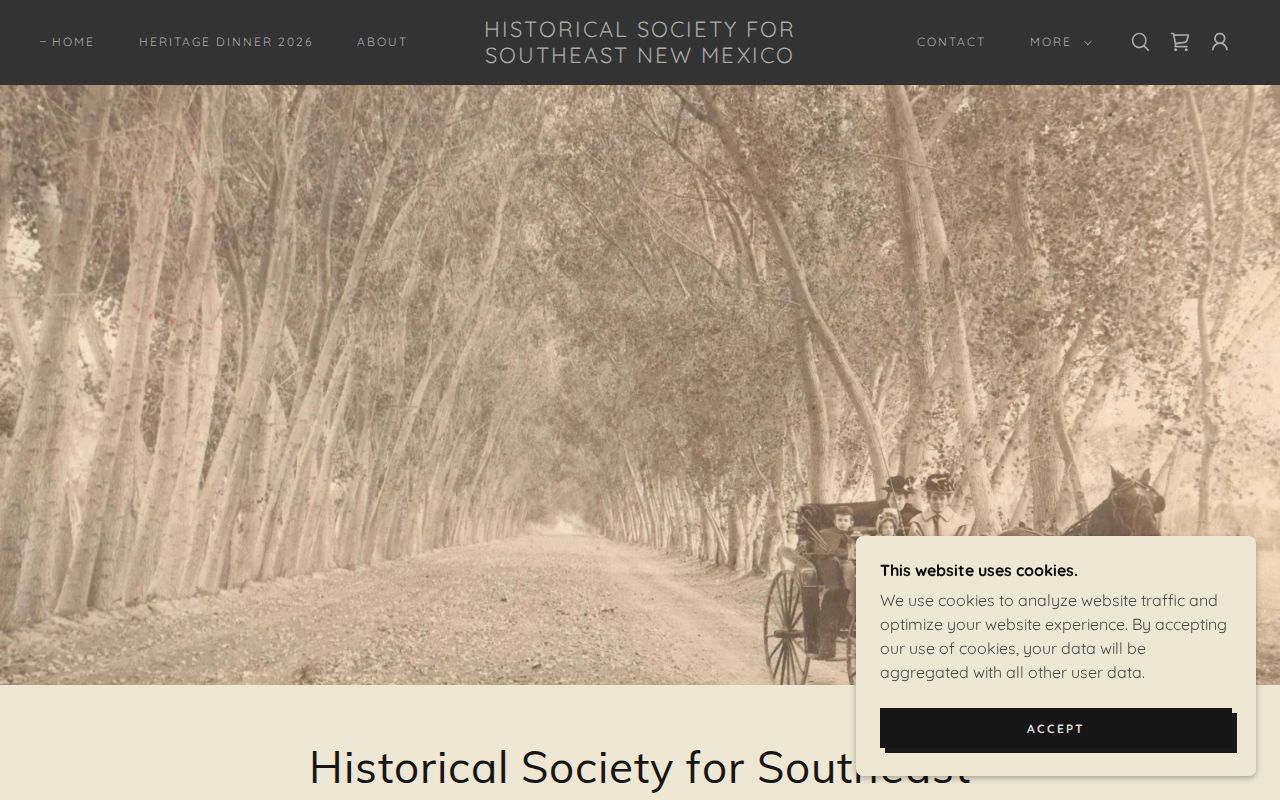
The historical-society archive route is useful for provenance and local context, while the map remains a building and street source rather than a directory of people.
Tracing Roswell City Directory Years
Family history becomes more reliable when city directory volumes are treated as a sequence. Start with a known date, not a current address. Compare the name spelling, street, and any printed household or business detail in the closest available volumes. The annual city directory and the federal census answer different questions. The former can provide an annual local listing; the latter is a household enumeration released on its own schedule. As of the research date, the 1950 census is the latest released federal census.
- Choose a target year and search the directory volume for the surname and forename spelling used at that time.
- Copy the entry, page image, address, and any printed occupation or household clue without expanding abbreviations from memory.
- Check the immediately earlier and later available Roswell volumes, using a reverse section only if that edition contains one.
- Pair the annual entries with the appropriate released census, a deed or assessment year, and the parcel legal description when an address is involved.
- Use a dated newspaper notice, probate record, cemetery office inquiry, or archive source to test a disappearance or important life event.
A person can disappear because of a changed spelling, household-head practice, an omitted volume, a move, or an unindexed page. Cross-check before choosing among those explanations. The library's Roswell Daily Record microfilm, which begins in 1903, is one local route for dated notices and obituaries.
Roswell Directory Newspaper Checks
Directory evidence gains context from the Roswell Daily Record, yearbooks, cemetery records, and local archives. Search a name or street within the right date range, then compare the item with the city directory image. A newspaper may abbreviate or misspell a name, so it is useful corroboration rather than a replacement for the volume or record custodian. The library's archive options and microform scanner give different ways to inspect the original local source.
When neither the online collection nor the library shelf resolves a question, the Historical Society for Southeast New Mexico accepts archive research inquiries by appointment, and New Mexico Archives Heritage Search provides a statewide finding-aid and request path. Save the collection name, volume, page, or image identifier for every lead.
Roswell Directory Source Notes
Keep a short provenance line for each Roswell city directory result: collection, volume year, page or image, exact printed name, address wording, and the date consulted. Separate an index hit from the scanned page. That practice makes later corrections possible and prevents a historical listing from being read as a current claim about a person or place.
For a request that concerns city-held historical material rather than a published directory, Roswell's NextRequest portal is the municipal IPRA channel. Ask for a defined record group and date range; the city is not required to create a new analysis or person search.
Use the City channel only for records the City creates or keeps. County deeds, probate material, and election records belong with Chaves County offices. State-held archival material has its own catalog and request process. Keeping the custodian separate from the collection avoids a common dead end: a perfectly described request sent to an office that never held the original volume or record.